

The jury is deliberating. The case went to twelve jurors shortly before noon on August 27. Follow the closings, the charge, and what happens next.
Plymouth County Superior Court, August 25, 2026. The Lindsay Clancy murder trial is nearly over. The defense rested on Friday, the Commonwealth spent Monday on rebuttal experts, and closing arguments are now expected Thursday. Once Judge William Sullivan instructs the jury, twelve people will decide whether the Duxbury mother who strangled her three children in January 2023 was criminally responsible when she did it. This article explains, step by step, what happens to her if the answer is yes.
A guilty verdict on first-degree murder means one sentence
Clancy faces three counts of first-degree murder, one for each child. Massachusetts gives a judge no discretion here: a first-degree murder conviction for an adult carries a mandatory sentence of life in prison without the possibility of parole. There is no sentencing hearing where mitigation gets weighed, no range for Judge Sullivan to work within, and no parole board review later. If the jury convicts on even one of the three counts, Lindsay Clancy will be sentenced to die in state custody.
Whether the sentences on multiple counts run concurrently or consecutively would not change her practical situation. Life without parole is the ceiling and the floor.
Women serving Massachusetts state prison sentences are held at the women’s facility in Framingham. Clancy’s case would add a complication the Department of Correction rarely faces in a murder case: she is paralyzed from the waist down after jumping from a window of the family home the night of the killings, and she has attended the entire trial in a wheelchair. Where and how the DOC houses a paraplegic lifer involves medical classification decisions that would follow sentencing, not the verdict itself.
The appeal is automatic, and it is unusually powerful
Every first-degree murder conviction in Massachusetts goes straight to the Supreme Judicial Court. That is not a choice the defense makes; it happens by statute, G.L. c. 278, § 33E. And § 33E review is broader than an ordinary appeal. The SJC examines the whole case, the law and the evidence, and can grant relief if the verdict was against the law or the weight of the evidence “or for any other reason that justice may require.” The court can order a new trial. It can also do something almost no other appellate court in the country does: reduce the verdict itself, entering a conviction of a lesser degree such as second-degree murder without any retrial.
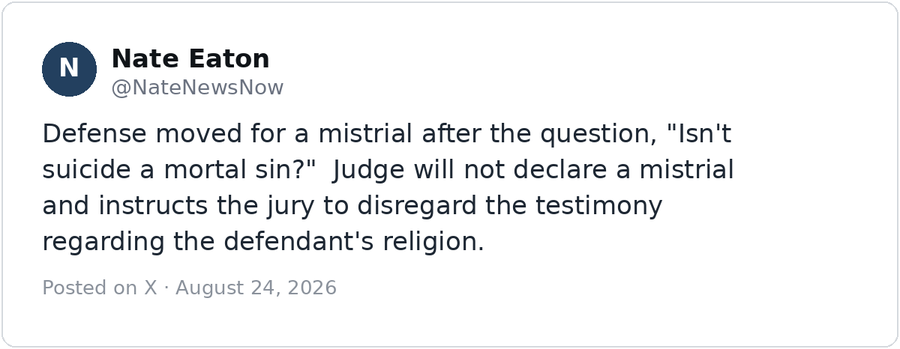
Defense attorney Kevin Reddington has already built part of that record. On Monday he moved for a mistrial after the Commonwealth’s rebuttal psychologist, Dr. Kirk Heilbrun, testified about asking Clancy whether suicide was a “mortal sin” and about her belief that she and her children would be together in heaven. It was the second time religion had come into the Commonwealth’s questioning. Judge Sullivan denied the mistrial but struck the testimony as “immaterial, irrelevant and to be disregarded” and warned prosecutors in what he called the strongest language. A denied mistrial motion preserved over a curative instruction is exactly the kind of issue the SJC scrutinizes under § 33E, and in a first-degree case the court would reach it even if trial counsel had said nothing.
Section 33E review takes time. Briefing and argument in a case with a nineteen-day trial record would likely stretch well over a year. Clancy would serve her sentence while it runs.
If the jury convicts on second-degree murder instead
Juries in Massachusetts murder trials are instructed on lesser-included offenses where the evidence supports them, and second-degree murder is the classic compromise verdict in a case where jurors accept that the defendant killed intentionally but balk at premeditation, or simply cannot agree on the top charge. The final list of options on the verdict slip will be set when Judge Sullivan charges the jury.
Second-degree murder also carries a life sentence, but with parole eligibility. Under G.L. c. 279, § 24, the judge sets the minimum term before parole eligibility somewhere between 15 and 25 years. That is a real sentencing decision, made after a hearing, and it is the one place in a murder conviction where Clancy’s psychiatric history, her medical condition, and everything her family said from the witness stand could still matter. Parole eligibility is not release; it is the right to ask a parole board, which says no far more often than yes to lifers, and would be saying it to a woman convicted of killing three children.
The other verdicts on the table
This article covers the guilty branch, but the jury has more than two doors. If it finds the Commonwealth failed to prove criminal responsibility beyond a reasonable doubt, the verdict is not guilty by reason of lack of criminal responsibility, and Clancy would move into the civil commitment system under G.L. c. 123, § 16 rather than walking out of the courthouse. We covered that path in detail here: what happens if Lindsay Clancy is found not criminally responsible. The short version: a 40-day psychiatric evaluation, then commitment proceedings the district attorney can drive, a six-month initial commitment, and yearly hearings after that for as long as she remains mentally ill and dangerous. Commitment can last decades. It can also end.
And if the twelve jurors cannot agree unanimously on any verdict, Judge Sullivan would eventually declare a mistrial. The charges would remain, and District Attorney Timothy Cruz’s office would decide whether to try the case again. Retrials after hung juries in high-profile murder cases are the norm, not the exception.
Why the guilty question is genuinely open
Nobody disputes what happened on January 24, 2023. The dispute is her state of mind, and Massachusetts law puts the burden on the Commonwealth to prove criminal responsibility beyond a reasonable doubt once the defense has raised it. Prosecutors spent the trial building premeditation: the takeout order timed with a 5:15 p.m. text sending her husband on an added CVS errand, the “Can you treat a sociopath?” search four days earlier, her treating psychiatrist’s testimony that she never appeared psychotic in fourteen visits, the last one the day before the killings. The defense answered with her December 2022 disclosure to her mother about thoughts of harming the children, the roughly ten psychiatric medications she had cycled through, and Dr. Phillip Resnick, the forensic psychiatrist from the Andrea Yates case, who examined her and concluded she was “frankly psychotic” and not criminally responsible. Our companion analysis weighs both sides: will Lindsay Clancy be found guilty or not guilty?
Questions readers keep asking
Will Lindsay Clancy go to jail if she is found guilty?
Yes. A first-degree murder conviction carries mandatory life in state prison without parole. A second-degree murder conviction carries life with parole eligibility after 15 to 25 years, a minimum the judge sets. Massachusetts houses women state prisoners at the facility in Framingham.
Can Lindsay Clancy appeal a guilty verdict?
A first-degree murder conviction is reviewed automatically by the Supreme Judicial Court under G.L. c. 278, § 33E. The SJC reviews the entire case and can order a new trial or reduce the conviction to a lesser degree of guilt.
Is Lindsay Clancy still married to Patrick Clancy?
No. Patrick Clancy, who testified for the prosecution over two days, is now her ex-husband.
Is Lindsay Clancy still paralyzed?
Yes. She is paralyzed from the waist down as a result of jumping from a window of the family’s Duxbury home the night of the killings, and she has used a wheelchair throughout the trial.
Where is Lindsay Clancy now?
She has been held in state custody since 2023 and was examined by both sides’ experts at Tewksbury State Hospital. She has been present in the Plymouth County courtroom every day of trial.
Follow the case as it reaches the jury: our Lindsay Clancy trial timeline is updated as events happen, and our preview of the closing arguments lays out what each side is expected to tell the jury.