

The jury is deliberating. The case went to twelve jurors shortly before noon on August 27. Follow the closings, the charge, and what happens next.
Nineteen trial days in, the question hanging over Plymouth County Superior Court has not changed since jury selection in July: was Lindsay Clancy criminally responsible on the night of January 24, 2023, when she strangled her three children in the basement of the family’s Duxbury home? Nobody contests that she caused their deaths. The verdict turns entirely on her mind, and with closing arguments now expected Thursday, this is an honest accounting of the evidence pointing each way, what the law actually requires, and what the people paid to predict these things are saying.
A caution before any of it: verdict predictions in insanity cases have a terrible track record. Andrea Yates was convicted by her first jury and acquitted by her second on nearly identical evidence. Treat everything below as a map of the terrain, not a forecast.
The question the jury must actually answer
Massachusetts uses the standard from Commonwealth v. McHoul, decided in 1967: a person is not responsible for criminal conduct if, at the time, as a result of mental disease or defect, she lacked substantial capacity either to appreciate the wrongfulness of her conduct or to conform her conduct to the requirements of law. Two separate prongs. A defendant who knew the act was wrong can still be not responsible if illness stripped her ability to stop herself.
The burden matters as much as the test. Under the model homicide instructions, once the defense has fairly raised lack of criminal responsibility, the Commonwealth must prove beyond a reasonable doubt that Clancy was responsible. The defense does not have to prove she was insane. If a single juror holds a reasonable doubt about her capacity on either prong, that juror cannot vote guilty. This allocation, among the most defendant-favorable in the country, is the main reason experienced Massachusetts lawyers rate the defense’s chances here higher than the public does.
The Commonwealth’s case for guilty
Prosecutors Jennifer Sprague and Shanan Buckingham built their case around planning and awareness.
The timeline came from Patrick Clancy himself. Lindsay ordered takeout from a Plymouth restaurant, then texted him at about 5:15 p.m. to also pick up children’s medicine at a CVS in Kingston, extending his errand. He returned around 6:00 p.m. to a locked bedroom door, blood, an open window, and his wife outside saying “I tried to kill myself.” The children were in the basement with exercise bands around their necks. The jury heard six minutes of his 911 call.
A State Police detective walked the jury through her phone: a search reading “Can you treat a sociopath?” four days before the killings, searches about methods of self-harm, notes and a medication journal. Her treating psychiatrist, Dr. Jennifer Tufts, saw her only by telehealth, in short video visits, the last of them the day before the killings. A nurse practitioner who also treated her, Rebecca Jollotta, testified she never observed signs of psychosis. A hospital chaplain who met with Clancy more than two hundred times after her arrest testified about a commanding voice, but prosecutors pointed out her contemporaneous notes never mentioned one. The CVS manager and the restaurant hostess who dealt with Clancy that evening described completely normal interactions.
The rebuttal experts sharpened the point. Dr. Avram Mack told the jury that “there’s no reason why psychosis in and of itself inhibits a person from knowing right from wrong.” Dr. Kirk Heilbrun, who spent about ten hours with Clancy, diagnosed bipolar II disorder and depression rather than psychosis, testified that her accounts of hallucinations shifted across interviews, and called a command voice that appears on a single night “very, very unusual.” His theory: she killed the children as part of a suicide plan, to spare them what she believed would be suffering after her death. Depressed and suicidal, but responsible.
The defense case for not guilty
Kevin Reddington’s answer starts thirteen months before the killings and runs on medication bottles. Clancy cycled through roughly ten psychiatric drugs in her final months, was admitted to McLean Hospital a month before the killings, and in December 2022 told her mother she was having thoughts of harming her children. Her mother quoted her from the stand: “This isn’t me. I just want to feel better and enjoy my kids again.” That disclosure is the defense’s cornerstone, because it is documented warning of exactly what happened, made while she was begging for treatment.
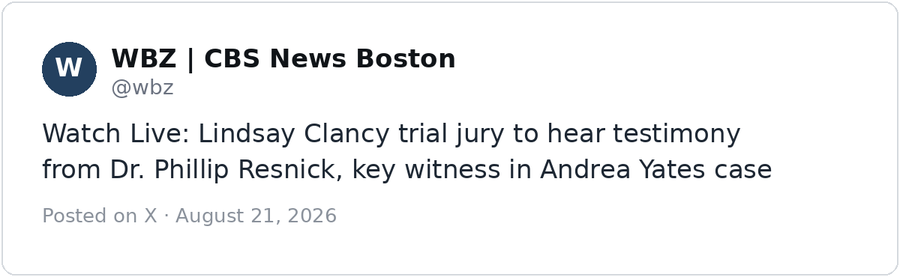
The psychiatric heavyweight was Dr. Phillip Resnick, the forensic psychiatrist consulted in the Andrea Yates and Jeffrey Dahmer cases, who examined Clancy at Tewksbury State Hospital. His diagnosis: postpartum psychosis with command hallucinations, a woman who “felt her body was taken over by an external force” and who was, in his words, “frankly psychotic” and not criminally responsible. A week after the killings, Patrick Clancy testified, Lindsay called him and described a man’s voice telling her that if she didn’t act she would lose her chance. And on cross-examination, Patrick agreed she had been a devoted mother, severely sleep-deprived and anxious, whose family had been assured she was safe around the children.
The defense also banked an unforced error by the Commonwealth. Twice, questioning touched Clancy’s Catholic faith and “mortal sin,” territory Judge William Sullivan had put off limits. On Monday he denied a defense mistrial motion but struck the testimony and rebuked the prosecution. Jurors were told to disregard it; whether twelve people can un-hear a suggestion that the defendant weighed sin and heaven is the kind of thing lawyers argue about for years afterward.
What the professionals predict, on both sides
Matt Murphy, the former California homicide prosecutor turned ABC News legal analyst, went further than most: his segment last week was titled, flatly, that Clancy will prevail. He pointed to the burden of proof and the depth of the documented psychiatric history. Veteran Los Angeles child-abuse prosecutor Jonathan Hatami published the opposite view this week, arguing that postpartum illness is real but that the evidence of planning demands accountability. The Atlantic ran an analysis under the headline “Why Lindsay Clancy’s Insanity Defense Might Fail,” pressing the same weakness Heilbrun did: contemporaneous corroboration of psychosis is thin. On social media the split is lopsided the other way among the public, with visible sentiment running roughly three to one for guilty, while a noticeable share of practicing lawyers who post about the case, including defense attorney Mark Bederow and several Massachusetts practitioners, rate the insanity defense as genuinely strong on this record. The gap between lay and professional opinion is itself a datum: the public is scoring the act, the lawyers are scoring the burden.
The realistic outcomes, ranked by what they require
A first-degree murder conviction requires all twelve jurors to find, beyond a reasonable doubt, both premeditation (or another theory the judge submits) and criminal responsibility. It carries mandatory life without parole; we detailed that path, including the automatic SJC appeal, in what happens if Lindsay Clancy is found guilty.
A not guilty by reason of lack of criminal responsibility verdict requires unanimous agreement that the Commonwealth fell short on responsibility. It would send Clancy into civil commitment under G.L. c. 123, § 16, with a 40-day evaluation, a six-month initial commitment, and annual reviews after that, explained in full here.
Between those poles sit the quieter endings. Second-degree murder, life with parole eligibility after 15 to 25 years, is the traditional landing spot for a jury that believes she was profoundly ill but not ill enough. And if the jury simply cannot agree, a hung jury and mistrial leave the district attorney free to try the whole case again to twelve new people.
Questions readers keep asking
When will the Lindsay Clancy verdict come?
Closing arguments are now expected Thursday, August 27, followed by the judge’s instructions. Deliberations begin after that and have no time limit; juries in cases like this have returned in hours and in weeks.
What does the jury have to decide?
Whether the Commonwealth proved beyond a reasonable doubt that Clancy was criminally responsible, meaning she had substantial capacity to appreciate the wrongfulness of her conduct and to conform it to the law, and if so, the degree of murder.
Does Lindsay Clancy have to prove she was insane?
No. Once lack of criminal responsibility is raised, Massachusetts places the burden on the prosecution to prove she was responsible, beyond a reasonable doubt.
What did Patrick Clancy say about the verdict?
He has not made a public prediction. In earlier public statements he asked for forgiveness for his wife; at trial he testified about the events of January 24, 2023 and about her mental state in the preceding months.
Could the jury hang?
Yes. Any verdict requires unanimity. If twelve jurors cannot agree, the judge declares a mistrial and prosecutors may retry the case.
We will cover the verdict the day it lands. Until then: the complete trial timeline, our breakdown of what each side is expected to argue in closings, and our explainer on how the insanity defense actually works in Massachusetts.