

Update, September 21, 2026. The Appeals Court issued a suppression ruling of its own today, affirming in a divided decision the suppression of a gun found in an inventory search. See our brief on Commonwealth v. Beechman.
At 6:01 on the morning of April 7, 2025, a regional SWAT team used a hydraulic spreader to tear open the locked front door of a two-family house at 61 Pond Street in Lowell. Nobody knocked. Nobody announced. The officers had a search warrant for the first-floor apartment, obtained six days earlier on the strength of three controlled drug buys. Once inside the common hallway they did knock on the apartment door, and a woman opened it with her hands up. Inside was the man they were looking for, in a wheelchair, and two children. In a safe they found two Glock pistols, loaded magazines, an assault rifle, Oxycodone, crack cocaine and cash.
None of it can be used. On August 4, 2026, Superior Court Judge David A. Deakin suppressed all of it, along with everything the defendant said that morning, in a 32-page decision that Massachusetts Lawyers Weekly reported this week as a case of first impression. The holding is simple to state and will matter in every double- and triple-decker in the Commonwealth: when police executing an ordinary warrant reach a locked exterior door that opens onto a shared hallway, they have to knock and announce there, not just at the apartment door inside.
The rule and where it comes from
The knock-and-announce rule is older than the Constitution. Officers executing a search warrant “must ‘knock and announce’ their presence and purpose before” entering, as the Supreme Judicial Court restated in Commonwealth v. Santiago, 452 Mass. 573 (2008), unless a magistrate has issued a no-knock warrant. The United States Supreme Court held in Wilson v. Arkansas, 514 U.S. 927 (1995), that the common-law rule is part of the Fourth Amendment’s reasonableness requirement. The rule serves three purposes, which Judge Deakin quoted from Santiago: “to protect the privacy interests of individuals; to minimize the likelihood of property damage; and to reduce the possibility of violence after an unannounced entry.”
Federal and Massachusetts law part ways on the remedy. In Hudson v. Michigan, 547 U.S. 586 (2006), the Supreme Court held that a knock-and-announce violation does not require suppression of evidence in federal court. Massachusetts never followed Hudson. Under Commonwealth v. Jimenez, 438 Mass. 213 (2002), and the Appeals Court’s decision in Commonwealth v. Ortega, 59 Mass. App. Ct. 217 (2003), a violation does not automatically require suppression either, but it can, and the question turns on two factors: “the degree to which the violation undermined the principles underlying the governing law” and “the extent to which exclusion will tend to deter such violations from being repeated.”
Police who fear violence or destruction of evidence can ask for a no-knock warrant. Under Jimenez they must show the magistrate particular reasons. The Lowell warrant was not a no-knock warrant. The magistrate who issued it required the police to knock, and, as the ACLU of Massachusetts put it to Lawyers Weekly, “the SWAT team chose to ignore that important guardrail.”
The question nobody had answered
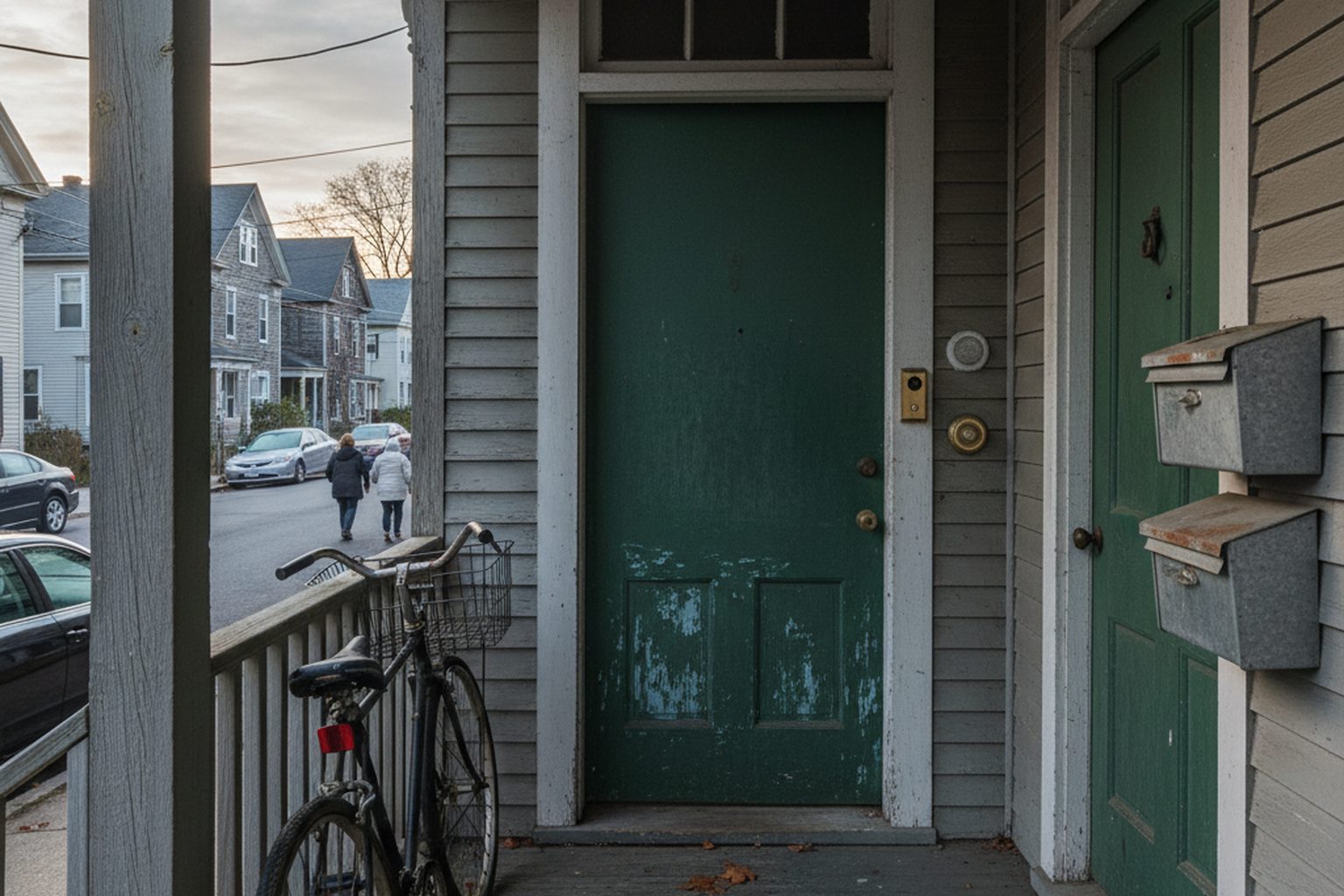
Where is “the door”? In a single-family house it is obvious. In an apartment building with a lobby the public can walk into, courts have generally said the common areas are not private and the rule applies at the apartment door. Judge Deakin wrote that there “appear to be surprisingly few cases” on the situation in between: a small two-family house with a locked exterior door that the two households share.
The Commonwealth argued that the hallway was a common area, that the defendant had no reasonable expectation of privacy in it, and that knocking at the apartment door was enough. The judge disagreed on the first point. The door was locked. The hallway was not open to the public. The two households of a two-family had “an expectation that members of the public could not enter the common hallway without the permission of a resident or the landlord.” That expectation was enough to require the police to announce themselves before breaking the door.
The judge was careful to say the analysis is fact-specific. He distinguished large multi-unit buildings. He noted that no Massachusetts appellate court has ruled on the point, and that courts elsewhere disagree. Boston defense lawyer Megan Siddall, who was not involved, told Lawyers Weekly that the caution may limit the decision, “but given the number of double and triple deckers in Massachusetts, this is a fact pattern that will play out over and over again.”
Why knocking at the apartment door did not cure it
The Commonwealth’s fallback was that the officers did knock and announce at the door to Unit 1, so the policies behind the rule were “substantially fulfilled” and nothing was gained by exclusion. Judge Deakin went through the three purposes one at a time.
Privacy: breaking into the locked hallway “impinged on the defendant’s expectation” that strangers could not enter it. Property: “Had the police knocked and announced at the common front door, it is possible that the door would not have been extensively damaged, as it was when the officers used the hydraulic spreader to pull the door apart from the jam.” Violence: “the possibility that residents of the units might have mistaken the officers’ forced entry, with no announcement, for a home invasion created or increased the risk that residents might have resorted to violence based on a misapprehension of the situation.”
The Commonwealth suggested that requiring police to knock at the outer door would increase danger to officers. The judge’s response, in a footnote, was that the Commonwealth “does not, however, suggest why this is the case,” and that if officers feared armed occupants “they can seek a ‘no-knock’ warrant.” They had not.
Defense counsel Amy Codagnone noted one more detail to Lawyers Weekly: the initial police report said that knocking and announcing had occurred. “Perhaps there was some miscommunication between the team that did the entry and the team that wrote the report, but it suggests to me that police knew they were supposed to.” Whatever the explanation, the hearing evidence showed it did not happen at the outer door, and the Commonwealth did not dispute that.
The second problem: a six-day-old warrant
The decision would have been news on the knock-and-announce ruling alone. Judge Deakin gave a second, independent reason to suppress. The warrant was issued April 1 and executed April 7. Under G.L. c. 276, § 3A, a search warrant must be returned to the court within seven days of issuance, so the execution was within the statutory window. But probable cause has its own clock. The last controlled purchase was up to three days before the affidavit, so nine or ten days passed between the last buy and the search, and drugs, as the Appeals Court has said, are “consumed or destroyed” rather than kept.
In Commonwealth v. Wade, 64 Mass. App. Ct. 648 (2005), a warrant executed on a car four days after issuance and five days after the last controlled purchase was held untimely. The Lowell delay “was twice the period found to be untimely in Wade,” and the affidavit contained no allegation that the defendant stored drugs at home. The judge called the issue “concededly quite close” but found probable cause had gone stale.
The statements went with the evidence. The defendant’s first denial that there were guns in the apartment was made in response to custodial questioning without Miranda warnings. His later statement that guns were in a safe was not shown to have been volunteered rather than prompted. And the statements he made after warnings in the kitchen followed too closely on the unwarned questioning to be separated from it. All were suppressed, both as fruit of the unlawful entry and on Miranda grounds.
What it means
For police, the safest reading is the simplest: if the warrant says knock, knock at the first locked door. If there is reason to think that is dangerous, say so to the magistrate and ask for a no-knock warrant, which is what Jimenez provides for. A regional tactical team that plans an entry without the local detectives present, as happened here, is the fact pattern that produces these cases.
For residents of two- and three-family houses, the decision confirms that a locked shared door is not a public lobby. The landlord’s key and the tenants’ keys define who may enter, and the police are bound by that unless a judge says otherwise.
For the case itself, the Commonwealth may seek leave to appeal the suppression order to the Appeals Court, which is the route by which a Superior Court decision on a novel question becomes binding law statewide. Whether the Middlesex District Attorney does so has not been reported. The defendant, Clifford Lawrence, is presumed innocent of the charges, which remain pending.
What did Commonwealth v. Lawrence decide?
That police executing an ordinary search warrant at a two-family house must knock and announce at the locked exterior door to the shared hallway before forcing it open, and that failing to do so required suppression of everything seized.
Do police have to knock before entering an apartment building?
At the apartment door, yes, unless they have a no-knock warrant. Whether they must also knock at a shared exterior door depends on the building. Lawrence holds they must at the locked common door of a small two-family; large buildings with public lobbies are treated differently.
Is evidence thrown out in Massachusetts for a knock-and-announce violation?
It can be. Unlike federal courts after Hudson v. Michigan, Massachusetts courts weigh how badly the violation undermined the rule’s purposes and whether exclusion will deter repeats.
How long is a search warrant good for in Massachusetts?
It must be returned within seven days of issuance under G.L. c. 276, § 3A, but probable cause can go stale sooner. For drugs, delays of a week or more after the last controlled buy have been held untimely.
Is this decision binding on other courts?
No. It is a Superior Court decision, persuasive but not precedent. It becomes binding only if the Appeals Court or Supreme Judicial Court adopts its reasoning.
Decision read in full: Commonwealth v. Lawrence, Middlesex Superior Court, Memorandum of Decision and Order on Motion to Suppress (Deakin, J., Aug. 4, 2026), Lawyers Weekly No. 12-038-26, 32 pages. Attorney comments from Massachusetts Lawyers Weekly, September 21, 2026. Santiago, Jimenez, Ortega, Wade, Wilson v. Arkansas, Hudson v. Michigan and Richards v. Wisconsin verified on CourtListener. G.L. c. 276, § 3A read at malegislature.gov. The defendant is presumed innocent. General information about Massachusetts law, not legal advice.