

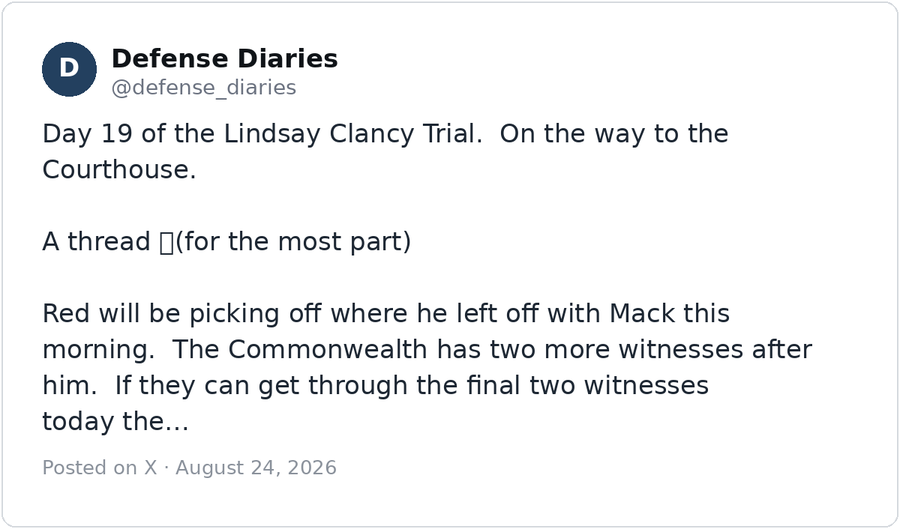
Updated Tuesday, August 25, 2026. The evidence phase of the Lindsay Clancy murder trial is down to its final hours. The defense rested Friday after its star psychiatric witness. The Commonwealth’s rebuttal case filled Monday and continues Tuesday with its last one or two witnesses. Barring another disruption, closing arguments are expected Wednesday in Plymouth County Superior Court, and the case goes to the jury after Judge William Sullivan’s instructions. This page previews what each side is expected to tell the jury, built from what actually happened across nineteen trial days, and we will update our trial timeline as the arguments land.
One procedural note that surprises people: in Massachusetts the defense argues first and the prosecution argues last. Kevin Reddington will stand up first; the Commonwealth gets the final word before the jury is charged.
The closing Kevin Reddington is expected to give
The defense closing writes itself backward from the burden of proof. Reddington does not have to convince the jury that Lindsay Clancy was insane. He has to leave at least one juror with a reasonable doubt about whether the Commonwealth proved she was criminally responsible. Expect him to say that sentence, in some form, a dozen times.
The pieces he has to work with, all of them in evidence:
The warning nobody acted on. In December 2022, a month before the killings, Clancy told her mother she was having thoughts of harming her children, and said “This isn’t me. I just want to feel better and enjoy my kids again.” A woman hiding a plan does not announce it to her mother while begging for treatment. Expect this to open or close the argument.
The medication spiral. Roughly ten psychiatric drugs in her final months, a McLean Hospital admission a month out, and a telehealth prescriber who never saw her in person during the critical stretch. Reddington previewed this theme before trial, calling her overmedicated, and Patrick Clancy conceded on cross that his wife was severely sleep-deprived, anxious, and had been described to the family as safe.
Resnick. Dr. Phillip Resnick has evaluated filicide cases for half a century, including Andrea Yates. He examined Clancy and told this jury she suffered postpartum psychosis, experienced command hallucinations, “felt her body was taken over by an external force,” and was “frankly psychotic” on January 24, 2023. Expect Reddington to set Resnick’s decades against the ten hours the Commonwealth’s rebuttal expert spent on his interviews, three years after the fact.

The voice she reported unprompted. A week after the killings, in a phone call Patrick testified about, she described a man’s voice telling her that if she didn’t act now she would lose her chance. That account predates any defense strategy, and the hospital chaplain who met with her more than two hundred times heard the same account.
The Commonwealth’s conduct. Twice the prosecution’s questioning brought Clancy’s Catholic faith and “mortal sin” before the jury, drawing a struck record, a curative instruction, and a rebuke from the bench. Reddington moved for a mistrial and lost, but expect a version of this in closing: a case this strong should not have needed that.
The emotional register will matter as much as the logic. Reddington’s task is to reframe the worst facts, the errand text above all, as the mechanics of a suicide plan directed by illness rather than the cunning of a murderer, and to remind jurors that a not guilty by reason of lack of criminal responsibility verdict is not an acquittal that opens the courthouse door. She would be committed, likely for years, possibly for life.
The closing the Commonwealth is expected to give
Prosecutors Jennifer Sprague and Shanan Buckingham will close on planning, awareness, and the silence in the records.
The errand. Takeout ordered from Plymouth, then the 5:15 p.m. text asking Patrick to add a CVS stop in Kingston for children’s medicine. He was gone about forty-five minutes. The Commonwealth’s theory from opening statements has been that she engineered that window, and the text message is its single best exhibit: a concrete, timestamped act of arrangement.
The searches. “Can you treat a sociopath?” typed into her phone four days before the killings, alongside searches about methods of self-harm. Expect the argument that this is a mind examining itself and researching an exit, not a mind seized by an external force.
The professionals who saw nothing. Dr. Jennifer Tufts, her treating psychiatrist, saw her fourteen times in four months, the last visit the day before the killings, and never observed psychosis. The CVS manager and the restaurant hostess who spoke with Clancy that evening noticed nothing unusual. Psychosis severe enough to erase responsibility, the Commonwealth will say, does not hide from every single person who looked.
The record that never mentions a voice. The chaplain’s notes from more than two hundred meetings contain no reference to command hallucinations. Dr. Kirk Heilbrun told the jury her accounts shifted across interviews and that a commanding voice appearing on one night only is “very, very unusual.” Dr. Avram Mack added that psychosis, even if present, does not by itself strip a person of the knowledge that killing is wrong.
The alternative story. Heilbrun gave the Commonwealth its narrative frame: a depressed, suicidal woman who decided to die and took her children with her, believing she was sparing them. That story accepts her suffering and still ends in guilty, because under Commonwealth v. McHoul the question is capacity, not diagnosis. Expect the closing to hand jurors that distinction explicitly: sick is not the same as not responsible.
The Commonwealth argues last, so it also gets the rebuttal positioning: whatever Reddington makes of Resnick, prosecutors answer it with no reply available.
After the closings
Judge Sullivan will instruct the jury on the law, including the McHoul standard and the Commonwealth’s burden to prove criminal responsibility beyond a reasonable doubt, and will settle the verdict slip. The realistic options run from first-degree murder, which carries mandatory life without parole, through second-degree murder, to not guilty by reason of lack of criminal responsibility, which leads to civil commitment rather than release. We have mapped every branch: what happens if she is found guilty, what happens if she is found not criminally responsible, and an honest weighing of which is more likely.
Deliberations have no clock. Twelve jurors, three counts, one question underneath all of it.
Questions readers keep asking
When are the Lindsay Clancy closing arguments?
They are expected Wednesday, August 26, 2026, once the Commonwealth’s final rebuttal witnesses finish. The schedule can move; check the trial timeline for live updates.
Who gives the closing argument first?
In Massachusetts the defense closes first and the prosecution closes last, the reverse of the order most people expect from television.
How long will the jury deliberate?
There is no limit and no way to predict it. The jury deliberates until it reaches a unanimous verdict on each count or reports that it cannot.
Was there a mistrial in the Clancy case?
No. The defense moved for a mistrial on August 24 after a prosecution expert referenced “mortal sin” in his testimony. Judge Sullivan denied the motion, struck the testimony, and instructed the jury to disregard it.
Did Lindsay Clancy testify?
No. She did not take the stand. The defense case rested on family witnesses, treatment records, and psychiatric experts.