

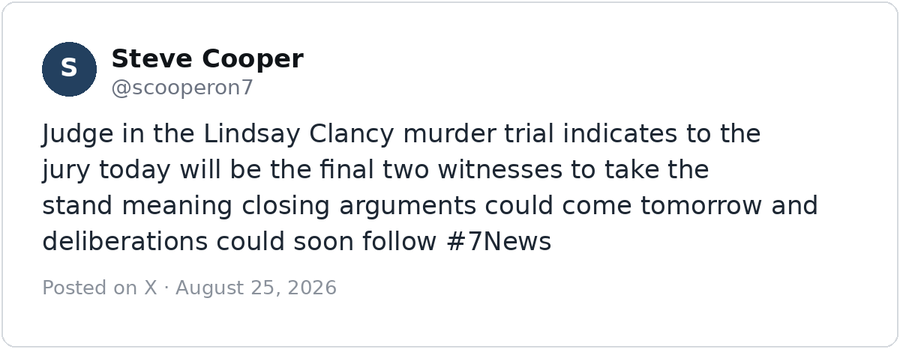
Plymouth County Superior Court, Tuesday, August 25, 2026, Day 20. The Lindsay Clancy murder trial is one day from the end of testimony. Judge William Sullivan told jurors this morning that today would bring the final two witnesses, which puts closing arguments on track for Wednesday and sends the case to the jury shortly after. And on the way out, the Commonwealth’s last expert left behind a sentence the defense will spend its closing trying to erase.
Four words that cut at the heart of the defense
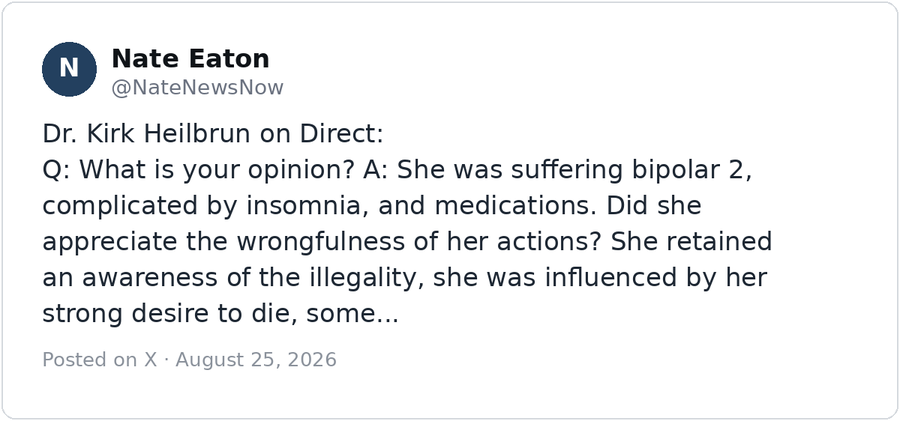
Dr. Kirk Heilbrun, the forensic psychologist the Commonwealth called to answer the defense psychiatrists, returned to the stand for continued direct examination. Asked for his opinion, he told the jury that Clancy suffered from bipolar II disorder, complicated by insomnia and by her medications. Then came the part that matters legally. Asked whether she appreciated the wrongfulness of her actions, Heilbrun said she retained an awareness of the illegality of what she was doing, and that she was influenced by a strong desire to die.
Massachusetts does not ask whether a defendant was mentally ill. Under the standard from Commonwealth v. McHoul, it asks whether mental illness robbed her of the substantial capacity either to appreciate that her conduct was wrong or to stop herself from doing it. Heilbrun’s answer concedes the illness and denies the incapacity. He is telling twelve jurors that they can believe every word about her suffering and still convict.
The prosecution’s alternative to psychosis
The more consequential piece of Heilbrun’s testimony may be a phrase most people have never encountered. He walked the jury through peritraumatic dissociation, describing it as an experience in which “things are unreal, it sounds psychotic but it happens when going through a traumatic set of circumstances.”
That single concept is the Commonwealth’s escape hatch. For months the defense has built its case on Clancy’s own descriptions of a commanding male voice and a sense that her body had been taken over by something outside her. Heilbrun is not calling her a liar. He is offering jurors a second explanation for the same reported experience, one that sounds like psychosis from the inside without meeting the legal definition. If the jury accepts it, the defense loses its bridge from her symptoms to a not guilty verdict.
It follows the testimony he gave Monday, which Law&Crime described as questioning her claim that a voice commanded the killings and pointing instead to a suicide attempt. The Guardian’s headline on today’s proceedings put it plainly: the psychologist doubts she was hallucinating.
Reddington’s cross
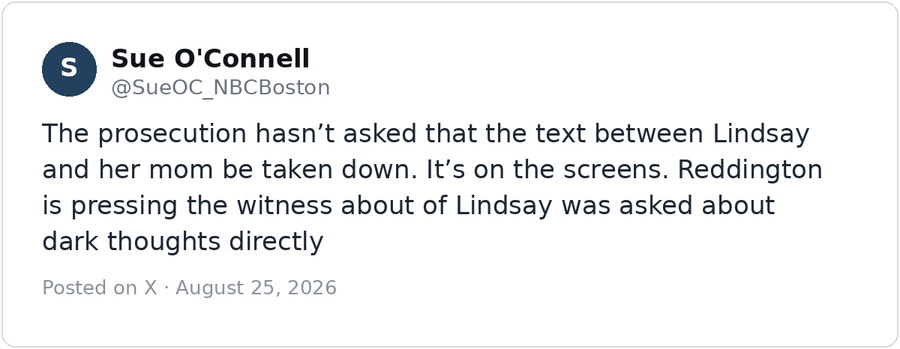
Defense attorney Kevin Reddington spent the afternoon pressing. He pushed Heilbrun on whether Clancy was ever asked directly about dark thoughts, while a text message between Lindsay and her mother stayed up on the courtroom screens, a message the prosecution never asked to have taken down. Commentator Sue O’Connell, watching from inside the courtroom for NBC10 Boston, noted that detail as it happened.
Reddington also questioned the witness about his own writing on how to handle difficult cross-examinations, a line of attack aimed squarely at the idea that an expert who teaches testimony is performing rather than reporting. The temperature outside the courtroom matched the temperature inside it: Reddington arrived at court this morning and told a commentator waiting for him, on camera, “You are a biased weasel.”
What happens next, and how fast
If the schedule holds, closing arguments come Wednesday. In Massachusetts the defense argues first and the Commonwealth argues last, which means Reddington speaks knowing prosecutors get the final word. Judge Sullivan then instructs the jury on the law, including the McHoul standard and the burden that sits on the Commonwealth to prove Clancy was criminally responsible beyond a reasonable doubt, and settles which verdicts appear on the slip.
After that there is no clock. Deliberations run until twelve people agree or report that they cannot.
We have mapped where each ending leads: what each side is expected to argue in closings, an honest weighing of guilty against not guilty, what a guilty verdict would mean, and what happens if she is found not criminally responsible. Our running trial timeline is updated as events happen.
Questions readers are asking today
When are closing arguments in the Lindsay Clancy trial?
Judge Sullivan indicated to jurors on Tuesday, August 25 that the day’s two witnesses would be the last, which puts closing arguments on track for Wednesday, August 26. Court schedules move, so treat it as expected rather than fixed.
What did Dr. Kirk Heilbrun say?
He testified that Clancy suffered from bipolar II disorder complicated by insomnia and medications, that she retained an awareness of the illegality of her actions, and that she was influenced by a strong desire to die. He also described peritraumatic dissociation as an experience that can sound psychotic without being psychosis.
What is peritraumatic dissociation?
As Heilbrun described it to the jury, it is an experience during traumatic circumstances in which things feel unreal. His point was that it can resemble psychosis from the inside without meeting the clinical or legal threshold for it.
Was there a mistrial in the Clancy case?
No. The defense moved for one on Monday after a second reference to Clancy’s Catholic faith and the idea of suicide as a mortal sin. Judge Sullivan denied the motion, struck the testimony, and instructed jurors to disregard it.
How long will the jury take to reach a verdict?
There is no way to predict it and no time limit. Any verdict must be unanimous on each count.
This article reflects reporting from inside the courtroom as of the afternoon of Tuesday, August 25, 2026, and will be updated as the trial reaches closing arguments.